22 September 2021 | Various | 25582 views | .pdf | 159.72 KB
With the expansion of hatchery production, the demand for Artemia cysts has continued to increase. Annual consumption is now estimated at 3,500 – 4,000 tonnes, underpinning the production of over 900 billion crustacean post larvae and fish fry by a hatchery industry valued at more than USD 2 billion and the final production of over 10 million tonnes of high-value aquaculture species. With approximately 90 percent of the current Artemia production harvested from inland salt lakes, the future of the hatchery industry could be at risk and requires urgent attention. The workshop explored needs and opportunities for a new international initiative to guarantee a more sustainable provision of Artemia, both from farmed and natural sources.
2 September 2021 | Various | 34194 views | .pdf | 101.92 KB
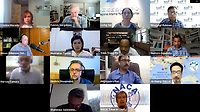
The goal of the webinar was to document differences in practices used by fish and crustacean hatcheries in the use of Artemia cysts for the preparation of live feeds. Over time, the practices used by hatcheries in Asia, Europe and Latin America have diverged from the good aquaculture practices for Artemia production recommended by FAO in the 1996 Live Food Manual. The technical programme included presentations from twelve speakers from around the world, with an introduction from the Director General of NACA, Huang Jie. The webinar was attended by 359 people from 53 countries. Video recordings of the technical presentations are enclosed, together with the report of the proceedings.
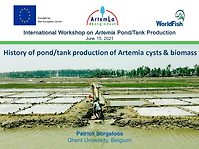
The International Workshop on Artemia Pond and Tank Production was held via Zoom / in Cox's Bazar, Bangladesh on 15 June 2021. A video recording of the presentations is enclosed and the report of the meeting is available for download.
To launch the new International Artemia Aquaculture Consortium, led by Patrick Sorgeloos, this conference series brings together professionals working on Artemia from all around the world. This event was a presentation on the world of Artemia for Saxon Bosworth, who was researching Artemia for an article for National Geographic. A video recording of the presentations is enclosed.
1 January 2016 | Litvinenko, L.I., Litvinenko, A.I, and Boyko, E.G. | 114 Downloads | .pdf | 187.4 MB
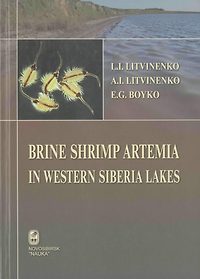
This monograph is written on the basis of studies carried out in the Siberian region from 1995 to 2004. The location of 83 Artemia lakes in huge territory from the Urals to the Altai and Sayan mountains, the characteristic of climate, lake morphometry, hydrology, hydrochemical classification of lakes are given in the monograph. Detailed description of biocenoses of salt lakes, including data on species composition of phytoplankton, zoobenthos and zooplankton and their productivity is presented in the paper. Functional dependence between number of species and index of water salinity is identified. The borders of occurrence of some species are determined.
The main part of monograph is devoted by the description of Artemia biology and morphometric studies for populations from 47 surveyed lakes in Siberia. Annual dynamics of brine shrimp cysts and crustaceans are documented based on monitoring data. The functioning of the ecosystems of the lakes are described including phytoplankton and Artemia production, crustacean consumption, and Artemia'srole in purification of reservoirs. Information about parthenogenetic and rare bisexual populations is provided and data from cytogenetic studies and DNA analysis are given. The problem of improving the quality of cysts associated with diapause is presented. In conclusion, the data on long-term dynamics of Artemia cysts stock in Siberian region were conducted.