Livelihoods and social issues

Content relating to socio-economic issues in Artemia production and value chains.

Copyright, all rights reserved.

In this collection
WAS 2026 Artemia Session presentations

An Artemia Session was held on 5 June at the World Aquaculture 2026 conference in Singapore. The session was facilitated by the International Artemia Aquaculture Consortium and covered the outcome of the World Bank PROBLUE Artemia Study Accelerating Brine Shrimp Artemia Aquaculture Production and Conservation for a Resilient Blue Economy.

The session featured case studies from China, Bangladesh, Thailand, Uzbekistan, Iran and Kenya. Presentations (PPTs and videos) from the session are available for download, and video presentations are available for viewing online. The session was chaired by Yeong Yik Sung and Patrick Sorgeloos.

Tapping into the global Artemia network: The International Artemia Aquaculture Consortium

Presentation by Yeong Yik Sung, Sui Liying & Patrick Sorgeloos at the Artemia Session held at the World Aquaculture 2026 conference in Singapore on 5 June 2026.

Accelerating brine shrimp Artemia production and conservation for a resilient mariculture

Presentation by Harrison Charo-Karisa, Ruth Garcia Gomez, Vivek Prasad, Michael Phillips and Patrick Sorgeloos at the Artemia Session held at the World Aquaculture 2026 conference in Singapore on 5 June 2026.

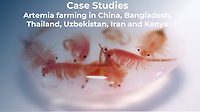
Case Studies: Artemia farming in China, Bangladesh, Thailand, Uzbekistan, Iran and Kenya

Presentation made at the Artemia Session held at the World Aquaculture 2026 conference in Singapore on 5 June 2026, including case studies from:

  • Artemia Production in Bohai Bay Solar Saltworks, China (Asian Regional Artemia Reference Center, Tianjin, China).
  • Artemia4Bangladesh Project (WorldFish).
  • Year-round Artemia biomass pond culture with integrated farming in Chachoengsao, Thailand (Bunjonk Farm).
  • Sustainable aquaculture in a changing landscape, Uzbekistan.
  • Artemia farming and natural production in Iran (Naser Agh).
  • Artemia farming in Kenya (Morine Mukami).

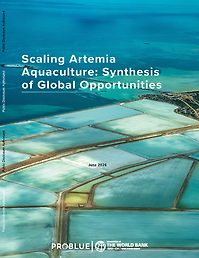
Scaling Artemia Aquaculture: Synthesis of Global Opportunities

This synthesis report consolidates over half a year’s worth of technical research, market analysis, and country level value chain assessments to present a comprehensive investment overview of the brine shrimp - Artemia - aquabusiness. Developed as part of the World Bank’s PROBLUE initiative on sustainable aquaculture and blue economy development, the report draws together the findings of six assessments, covering Artemia production systems, governance frameworks, markets and trade, emerging use cases, inventories of innovators, and in-depth country value chain studies.

The purpose of this synthesis report is to:

  • Provide an integrated overview of the current state and future potential of farmed Artemia systems.
  • Present investor-ready intelligence on country contexts, production models, and enabling conditions.
  • Guide strategic decision-making across public, private, and donor stakeholders through a concise but data-driven road map for investment and scale.

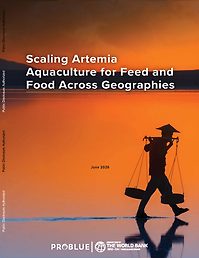
Scaling Artemia Aquaculture for Feed and Food Across Geographies

Artemia, commonly known as brine shrimp, is a critical live feed ingredient in aquaculture, particularly for shrimp and marine finfish hatcheries. The global Artemia industry is experiencing increasing demand driven by expanding aquaculture production. This report provides an in-depth analysis of Artemia in five key countries where Artemia aquaculture is established or in early stages of development — Viet Nam, China, Thailand, Bangladesh, and Kenya. The studies highlight Artemia value chains and associated production systems, market potential, and investment needs.

The findings confirm that Artemia can be successfully, profitably, and sustainably produced through aquaculture as cyst or biomass products in hypersaline environments, across diverse systems, providing important and critical products for aquaculture, with potential for wider application and product development as aquafeed and human food.

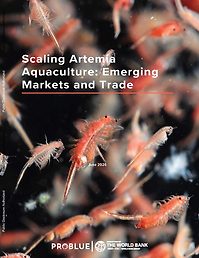
Scaling Artemia Aquaculture: Emerging Markets and Trade

This Global Artemia Emerging Markets and Trade report offers a comprehensive overview of Artemia products and markets, from global trends to country-level case studies. It provides an in-depth assessment of traditional and emerging uses, supply systems, investment opportunities, and strategic risks. The study is global in nature, with illustrative cases of ‘farmed’ Artemia in Bangladesh, China, Thailand, and Viet Nam in Asia and Kenya in Africa and how new farmed products can compete with wild Artemia products.

The report provides the quantitative foundation for the synthesis, linking the production and governance analyses with global trade, price, and investment trends. Together, six studies form a coherent analytical suite.

Bringing Fish Back to the Land the Water Left Behind

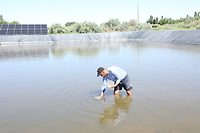
Artemia / snakehead farmer Ayapbergen Ajimuratov. Photo courtesy of UNDP Uzbekistan.

In Karakalpakstan, Uzbekistan, farmer Ayapbergen Ajimuratov is turning one of the region's most enduring problems into a livelihood. As the Aral Sea has shrunk over decades, it has left behind land saturated with saline water too salty to drink or irrigate crops with. Rather than treating it as waste, Ayapbergen has channelled it into six aquaculture ponds on a single hectare of land, becoming one of the first farmers in the district to cultivate Artemia and raise snakehead fish on a circular system where each stage feeds the next.

With support from a UNDP project backed by the Government of the Russian Federation, he received the ponds along with solar panels, a power transformer, a freezer for the harvest, and an on-site cabin. A community water purification system supplies around 1,500 cubic metres of saline water year-round. The farm is now producing fish and employing local workers - a small but meaningful step in rebuilding livelihoods in one of the world's most environmentally damaged regions.

Read the full story at the UNDP Uzbekistan website.

Bangladesh farmers transform salt farming with Artemia integration

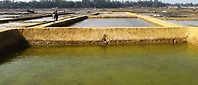
Farmers in Cox's Bazar, Bangladesh, have discovered how to transform seasonal salt farming into a year-round income source. By integrating artemia culture alongside traditional salt production, smallholder farmers are now cultivating fish, shrimp, and vegetables on the same land during the rainy season, with artemia ponds sitting alongside tilapia nurseries and vegetable gardens on pond dikes.

Supported by the EU's DeSIRA initiative, adopter farmers increased their earnings by at least 40%, with some demonstration farmers achieving gains of up to 83%. The artemia produced serves as high-quality live feed for shrimp hatcheries, tested at 51% crude protein and free of major pathogens. Women participants gained training in nutrition and hygiene, along with greater roles in household decision-making. This case study shows how integrated farming approaches can strengthen food security, improve livelihoods, and build climate resilience for coastal communities vulnerable to cyclones and flooding.

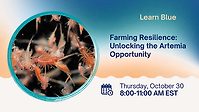
Unlocking the Artemia opportunity (webinar recording)

This webinar presented the results of an in-depth analysis of Artemia production, conservation and investment opportunities by the World Bank Group, with expert input from members of the International Artemia Consortium.

Artemia (brine shrimp) is a critical live feed in aquaculture, particularly in hatcheries for shrimp, fish, and ornamental species. Its production and sustainable management are increasingly important as aquaculture expands globally. Global Artemia markets face increasing demand, while new innovations in farming, processing, and conservation offer opportunities for inclusive investment, resilience, and biodiversity protection.

This event brought together global experts, policymakers, private sector representatives, and development partners to discuss the state of Artemia production and conservation, market opportunities, regulatory frameworks, and pathways for sustainable and viable investment.

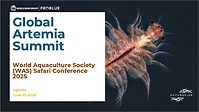
Global Artemia Summit held at WAS Safari 2025 in Entebbe

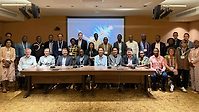
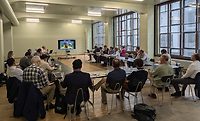
The Global Artemia Summit was held on 27 June 2025 in Entebbe, Uganda, as a special session during the World Aquaculture Society’s Safari Conference. Co-hosted by the World Bank and FutureFish, the event brought together experts, government officials, private sector stakeholders, and researchers to discuss strategies for enhancing Artemia aquaculture and conservation.

The summit addressed growing concerns over Artemia resource constraints due to overharvesting, environmental degradation, and climate impacts, while highlighting new opportunities for sustainable production, particularly in Africa. Sessions explored integrated Artemia-salt farming systems, human food applications, value chain development, and public-private investment models. Panel discussions and networking sessions promoted knowledge exchange and south-south collaboration.

Artemia production opportunities in Vietnam

Presentation made at the Global Artemia Summit, held 27 June in conjunction with WAS Safari 2025, Entebbe, Uganda. Presentation by Nguyen Van Hoa.

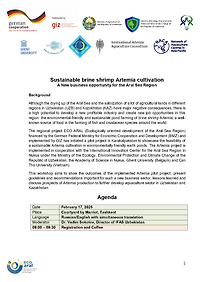
Workshop on sustainable brine shrimp Artemia cultivation, 17 February, Tashkent

Although the drying up of the Aral Sea and the salinization of a lot of agricultural lands in different regions in Uzbekistan (UZB) and Kazakhstan (KAZ) have major negative consequences, there is a high potential to develop a new profitable industry and create new job opportunities in this region: the environmental-friendly and sustainable pond farming of brine shrimp Artemia, a wellknown source of food in the farming of fish and crustacean species around the world. This workshop aims to show the outcomes of the implemented Artemia pilot project, present guidelines and recommendations important for such a new business sector, lessons learned and discuss prospects of Artemia production to further develop aquaculture sector in Uzbekistan and Kazakhstan.

Opening remarks: Safeguarding Artemia resources training

Opening remarks at the Training Programme on Safeguarding Salt Lake Brine Shrimp (Artemia) Resources for Aquaculture, held 2-6 September 2024 in Rome / Brussels. Speakers were: Xinhua Yuan, Philippe De Maeyer, Simon Wilkinson, Wang Zhongxiu.

Artemia pond production projects

Presentation by Nguyen Van Hoa and Patrick Sorgeloos at the Training Programme on Safeguarding Salt Lake Brine Shrimp (Artemia) Resources for Aquaculture, held 2-6 September 2024 in Rome / Brussels.

First International Artemia Aquaculture Consortium Conference and Members' Meeting

IAAC Members' Meeting with online dicussion panels

The first ever IAAC conference was a free half day even held in Ostend, Belgium on 9 September, as a prelude to Larvi 2024, which ran from 9-12 September. The conference featured twelve presentations introducing the IAAC and providing an overview of many of the issues surrounding Artemia, including management of salt lakes habitats that still provide the bulk of global Artemia supplies, Artemia biodiversity, hatching optimisation, and aquaculture of Artemia biomass in tanks and ponds. Video recordings of most will be posted shortly (the programme below will be updated with links).

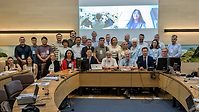
The first IAAC Members’ Meeting was held in the afternoon following the IAAC Conference. The proceedings involved two panel discussions, by the Academic Sector and Private Sector respectively. The panels included remote members participating via Zoom.

larvi 2024: Final announcement + first IAAC conference!

The 8th fish and shellfish larviculture symposium (larvi '24) will be held in Ghent University, Belgium, from 9-12 September 2024. Capitalising on the previous “larvi” symposia (in ’91, ’95, ’01, ’05, ’09, ’13, ‘17), the Aquaculture R&D Consortium of Ghent University, the Norwegian University of Science and Technology and SINTEF Ocean have joined again in the organizing committee for “larvi’24” and are inviting the academic as well as the private sector to attend the 8th Fish and Shellfish Larviculture Symposium. Bringing together European and non-European stakeholders, once again the latest progress in academic research and in the production sector will be reviewed, problems identified and avenues for future collaboration explored. Please download the 2nd announcement and programme for further information.

The first International Artemia Aquaculture Consortium conference will also be held in conjuction with larvi '24, on 9 September. See you there!

Larvi 2024 and first International Artemia Aquaculture Consortium conference

The first conference of the International Artemia Aquaculture Consortium will be organized on September 9, 2024 in Ostend, Belgium. The 8th International Fish & Shellfish Larviculture Symposium - Larvi ’24 - will be organised at the same venue in Ostend from 9-12 September 2024.

A more detailed first announcement with call for presentations will be mailed in the first week of October 2023. A preliminary website has been opened where you can register your interest to participate in this event.

Seminar on Artemia Research and Production: Exploring Translational Advancements, Global Perspectives, and Shared Benefits, Malaysia

The seminar was held on 28 July 2023 in Putrajaya, Malaysia, in conjunction with the first meeting of the International Artemia Aquaculture Consortium Steering Committee. Video recordings of the technical presentations are available in this collection.

NACA's role with the International Artemia Aquaculture Consortium

Presentation by Simon Wilkinson, Network of Aquaculture Centres in Asia-Pacific, at the Seminar on Artemia Research and Production, 28 July 2023, Putrajaya, Malaysia.