Practical guidance for hatcheries built on the FAO manual on Artemia production and use. These fact sheets demonstrate good practice in the use and handling of Artemia. They provide standard operating practices (SOPs) and quick-reference visuals for daily hatchery operations.
The fact sheets translate the detailed information contained in the FAO manual into a practical tool that supports the safe and effective production of high-quality Artemia for aquaculture hatcheries. By following these simple practices, hatchery operators can improve production while reducing cost and biosecurity risk.
The fact sheets were developed by the Artemia Reference Center, Ghent University, in consultation with IAAC members and stakeholders.
Download the whole collection here, or you can download individual sheets below.
5 June 2024 | Van Stappen, G., Sorgeloos, P. & Rombaut, G. (eds.) | 3046 views
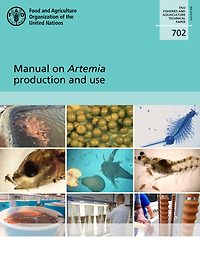
This FAO publication on brine shrimp is a manual for all those who are using Artemia or have an interest in this organism, whether as a source of live food in the hatchery, as a model organism in research, or for other purpose. It is intended for those who wish to update their knowledge on its biology, production or its use, but also for those who want to learn about Artemia for the first time. This manual presents in a concise form essential information on Artemia biology and the most important natural cyst resources that find their way to the aquaculture market. It also provides detailed information on general principles and practical procedures to produce Artemia in ponds and in tank systems. Finally, the manual offers a compilation of state-of-the-art guidelines and methodologies related to the use of this crucial live food organism in aquaculture.
19 September 2026 | Food and Agriculture Organization of the United Nations | .pdf | 3.2 MB
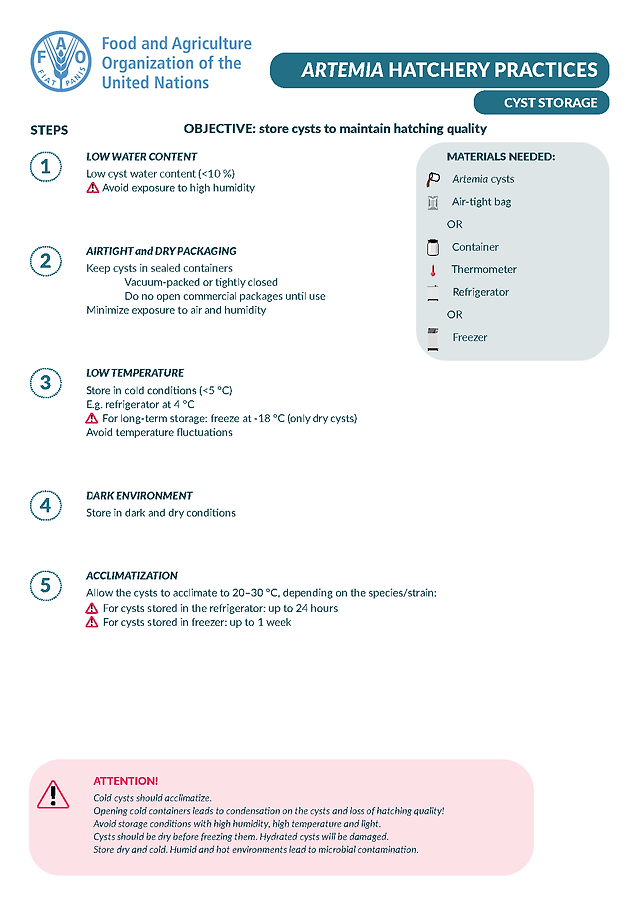
This technical guidance factsheet was developed as part of a series of practical on-farm hatchery management guides based on the FAO Artemia Manual. It provides a concise, user-friendly reference for hatchery operators on the proper storage of Artemia cysts to maintain their hatching quality and performance. The factsheet outlines key storage requirements, including maintaining low cyst moisture content, using airtight and dry packaging, storing cysts at low temperatures, protecting them from light and humidity, and allowing adequate acclimatization before use. By following these simple practices, hatchery operators can reduce quality losses during storage and ensure reliable hatching results. Presented in a highly visual format, the guide transforms the detailed information contained in the FAO Artemia Manual into a practical tool that supports the safe and effective production of high-quality Artemia for aquaculture hatcheries.
18 September 2026 | Food and Agriculture Organization of the United Nations | .pdf | 4.15 MB
This technical guidance factsheet was developed as part of a series of practical on-farm hatchery management guides based on the FAO Artemia Manual. It provides a concise, user-friendly reference for hatchery operators on the disinfection of Artemia cysts prior to incubation. The factsheet presents a practical step-by-step procedure covering cyst selection, hydration, disinfection using sodium hypochlorite (NaOCl), washing and deactivation of residual chlorine, and immediate application of treated cysts. It also highlights key safety precautions, required materials, and recommended operational conditions to ensure effective disinfection while maintaining cyst quality and minimizing risks to operators and the environment. The guidance aims to support improved hatchery biosecurity and more reliable Artemia production. Presented in a highly visual format, the guide transforms the detailed information contained in the FAO Artemia Manual into a practical tool that supports the safe and effective production of high-quality Artemia for aquaculture hatcheries.
17 September 2026 | Food and Agriculture Organization of the United Nations | .pdf | 1.63 MB
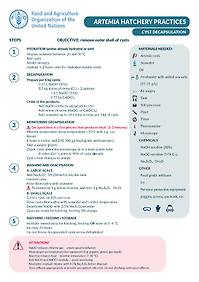
This technical guidance factsheet was developed as part of a series of practical on-farm hatchery management guides based on the FAO Artemia Manual. It provides a concise, user-friendly reference for hatchery operators on the decapsulation of Artemia cysts, a process that removes the outer shell to improve hatching efficiency, reduce contamination risks and allow the direct use of decapsulated cysts as feed. The document describes the complete procedure, from cyst hydration and chemical decapsulation to monitoring, washing, chlorine neutralization and storage. It also highlights essential safety measures, including the handling of hazardous chemicals, temperature control and proper effluent management. Presented in a highly visual format, the guide transforms the detailed information contained in the FAO Artemia Manual into a practical tool that supports the safe and effective production of high-quality Artemia for aquaculture hatcheries.
16 September 2026 | Food and Agriculture Organization of the United Nations | .pdf | 1.3 MB
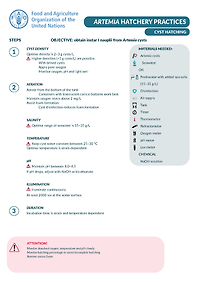
This technical guidance factsheet was developed as part of a series of practical on-farm hatchery management guides based on the FAO Artemia Manual. It provides a concise, user-friendly reference for hatchery operators on the hatching of Artemia cysts to obtain high-quality instar I nauplii. The factsheet summarizes the key operational parameters affecting hatching success, including cyst density, aeration, salinity, temperature, pH, illumination and incubation duration. It also highlights the materials required, recommended operating ranges and critical monitoring points to help ensure optimal hatching performance and consistent nauplii production under hatchery conditions. Presented in a highly visual format, the guide transforms the detailed information contained in the FAO Artemia Manual into a practical tool that supports the safe and effective production of high-quality Artemia for aquaculture hatcheries.
15 September 2026 | Food and Agriculture Organization of the United Nations | .pdf | 6.41 MB
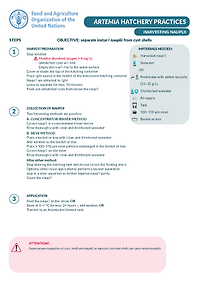
This technical guidance factsheet was developed as part of a series of practical on-farm hatchery management guides based on the FAO Artemia Manual. It provides a concise, user-friendly reference for hatchery operators on the harvesting of Artemia nauplii and their effective separation from unhatched cysts and empty shells. The factsheet describes key procedures for harvest preparation, nauplii collection using concentrator-rinser or sieve-based methods, and subsequent handling options, including direct feeding, short-term storage or enrichment. It also highlights critical operational considerations to maximize nauplii quality and purity while minimizing the risk of larval mortality associated with the presence of cyst shells. Presented in a highly visual format, the guide transforms the detailed information contained in the FAO Artemia Manual into a practical tool that supports the safe and effective production of high-quality Artemia for aquaculture hatcheries.
14 September 2026 | Food and Agriculture Organization of the United Nations | .pdf | 3.15 MB
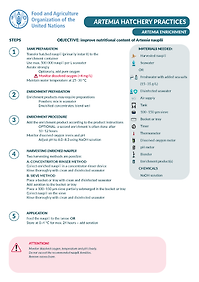
This technical guidance factsheet was developed as part of a series of practical on-farm hatchery management guides based on the FAO Artemia Manual. It provides a concise, user-friendly reference for hatchery operators on the enrichment of Artemia nauplii to enhance their nutritional value before feeding to fish and shrimp larvae. The factsheet outlines the key steps involved in nauplii enrichment, including tank preparation, enrichment product preparation and application, harvesting of enriched nauplii, and storage options. It also highlights critical operational parameters, such as nauplii density, dissolved oxygen, temperature and pH, to support effective enrichment and the production of high-quality live feed for hatchery operations. Presented in a highly visual format, the guide transforms the detailed information contained in the FAO Artemia Manual into a practical tool that supports the safe and effective production of high-quality Artemia for aquaculture hatcheries.
13 September 2026 | Food and Agriculture Organization of the United Nations | .pdf | 2.55 MB
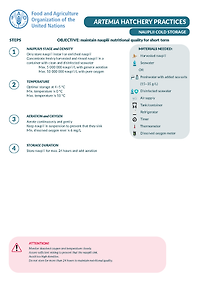
This technical guidance factsheet was developed as part of a series of practical on-farm hatchery management guides based on the FAO Artemia Manual. It provides a concise, user-friendly reference for hatchery operators on the cold storage of Artemia nauplii to maintain their nutritional quality for short-term use. The factsheet outlines key requirements for successful storage, including nauplius stage selection, stocking density, temperature control, aeration and oxygen management, and maximum storage duration. It also highlights critical monitoring points to help maintain nauplii quality and viability while ensuring a reliable supply of live feed for hatchery operations. Presented in a highly visual format, the guide transforms the detailed information contained in the FAO Artemia Manual into a practical tool that supports the safe and effective production of high-quality Artemia for aquaculture hatcheries.
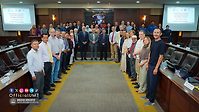
Getting Artemia preparation wrong costs hatcheries in survival rates, wasted cysts, and feed bills. At Partnerships to Practice: An Artemia Workshop, held at Universiti Malaysia Terengganu, industry, government, and researchers validated a new set of hatchery good-practice tools: SOP sheets, checklists, and demonstration videos covering Artemia biosecurity, enrichment, and biomass production in hatchery environments.
Delegates also discussed building a global inventory of Artemia genetic resources tracking genetic and nutritional characteristics, hatching rates and strain performance to help hatcheries pick the right strain for their systems instead of relying on guesswork. The goal of the practices, based on the FAO Manual on Artemia Production and Use, are to optimise yield and reduce wastage of expensive Artemia resources, and to provide instruction on cold storage, enrichment, and biosecurity on the hatchery floor.