
Biochemistry of Artemia Development
1 January 1979 | Bagshaw, J.C. and Warner, A.H. | 168 Downloads | .pdf | 161.26 MB
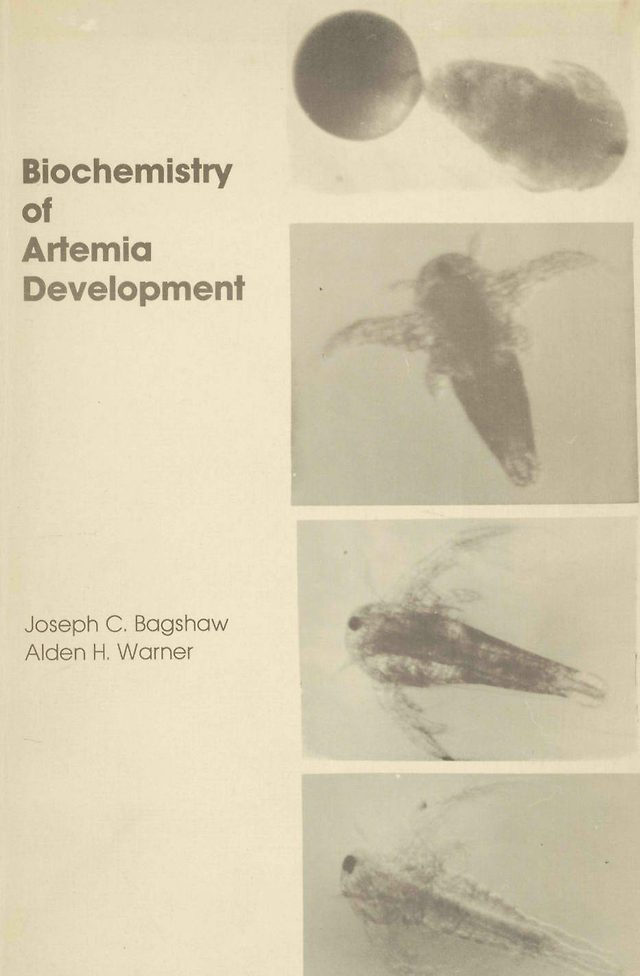
In recent years the brine shrimp, Artemia salina, has become increasingly important as a useful model system for biochemical studies of development. This volume contains the proceedings of a symposium on Artemia biochemistry - the first of its kind - held July 7, 1979 in Toronto. The speakers came from fourteen different laboratories in seven countries to present their work and to exchange ideas and information. All the participants were, of course, familiar with the developmental biology of Artemia.
Artemia salina is a small anostracan crustacean found in hypersaline bodies of water throughout the world. Fertilization occurs internally, and embryos develop in the ovisac of the female up to the early gastrula stage. At this point two pathways are possible. The embryos may continue to develop inside the ovisac, giving rise to free- swimming nauplius larvae, which are released. Alternatively, the embryos may enter a dormant state (cryptobiosis) and become encysted in a hard, chitinous shell. The dormant cysts are expelled from the ovisac and are dessicated first osmotically, then by wind and sun after being washed ashore. The encysted embryos, commonly but erroneously called brine shrimp "eggs", are collected and sold to aquarium suppliers and hatcheries; Artemia larvae are the best known food source for the fry of many commercially valuable species, availablity at any time in large quantity is only one of the practical advantages to the biochemist. The dormant embryos are completely ametabolic,. yet they will resume development immediately upon rehydration at a suitable temperature. About 16 hours after immersion of cysts in sea water at 30 C, nauplius larvae hatch out. The larvae will continue to develop synchronously for two days without feeding, and even longer if fed. Thus it is easy to obtain large quantities of embryos or larvae at any stage within this period. Many interesting biochemical phenomena can be observed and studied during this period of embryonic and larval development in Artemia - and therein lies the subject of this book.
1785736796_biochemistry-of-artemia-development.pdf
Copyright, all rights reserved.